
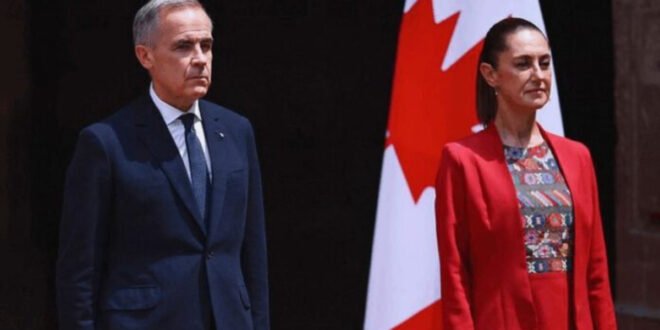
In a significant diplomatic shift, Canadian Prime Minister Mark Carney and Mexican President Claudia Sheinbaum met in Mexico City on December 18, 2025, to deepen bilateral ties and present a unified front against the protectionist policies of the United States.
This meeting, Carney’s first official visit to Mexico as prime minister, marks an intentional “reset” of the relationship following a year of friction. The two leaders pledged to expand cooperation on trade and security, emphasizing that a strong North American partnership makes all three nations more competitive globally. Despite the display of unity, both leaders acknowledged the immense economic strain caused by recent U.S. tariffs, including 50% levies on Canadian steel and a 25% “fentanyl tariff” imposed on Mexico.
The warmth between Carney and Sheinbaum stands in stark contrast to previous tensions, specifically last year’s incident where Canadian officials were accused of attempting to bypass Mexico to secure a bilateral trade deal with Washington.
During this visit, the leaders focused on shared interests ahead of the critical 2026 review of the United States-Mexico-Canada Agreement (USMCA). Political analysts suggest that by coordinating their strategies now, Canada and Mexico hope to avoid being pitted against one another by the Trump administration during formal negotiations.
While Carney has faced domestic criticism for failing to secure tariff relief, his decision to drop retaliatory measures against the U.S. suggests a shift toward more moderate, dialogue-based diplomacy similar to Sheinbaum’s calm approach.
The economic stakes are particularly high for Canada, whose exports to the U.S. have suffered more significantly in 2025 than Mexico’s. While the USMCA still exempts the majority of goods from broad duties, sector-specific tariffs on oil, gas, aluminum, and pharmaceuticals have disrupted long-standing supply chains.
By strengthening ties with Mexico—a trade relationship valued at over $40 billion—Canada seeks to diversify its economic reliance and bolster its leverage within North America. Experts noted that these “unprecedented times” have forced a redefinition of the Canada-Mexico relationship, moving it from a secondary priority to a central pillar of their respective foreign policies.