
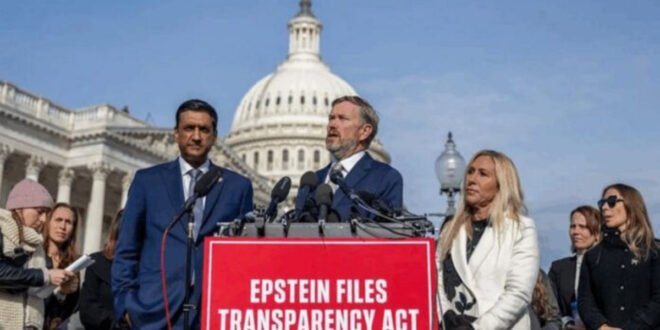
In a major bipartisan move, the U.S. government has enacted the Epstein Files Transparency Act, a law compelling the Department of Justice to release all unclassified records related to the late financier and sex offender Jeffrey Epstein.
The legislation, which passed the House 427–1 and received unanimous consent in the Senate, was signed into law by President Donald Trump on November 19, 2025. This marked a significant reversal for the President, who had previously resisted the disclosure before urging his party to support the measure following intense public pressure.
The law mandated a 30-day deadline for the Justice Department to make a searchable and downloadable library of investigative materials available to the public. These records include internal communications, flight logs from Epstein’s private aircraft, and details regarding his 2019 death in federal custody.
While Attorney General Pam Bondi was granted authority to redact information to protect victim identities or active investigations, the law explicitly prohibits withholding records based on political sensitivity or reputational harm.
As of late December 2025, the release has become a source of fresh political tension. On December 19, the Justice Department began publishing an initial trove of tens of thousands of documents, but the release was criticized by lawmakers and survivors for being heavily redacted and incomplete.
Tensions escalated on Christmas Eve when the Department of Justice announced it had suddenly discovered over a million additional documents that would require a few more weeks to process, effectively missing the statutory deadline. This delay prompted a dozen U.S. Senators to call for an inspector general audit of the Department’s failure to comply with the law.
The initial batches released in late December have already fueled headlines by confirming that Donald Trump flew on Epstein’s private jet at least eight times in the 1990s, which was more frequent than previously known. The files also contain references to other high-profile figures such as Bill Clinton, Michael Jackson, and Prince Andrew, though their inclusion does not necessarily imply wrongdoing.
President Trump has since criticized the disclosure process as a scam and a distraction, even using social media to attack the bill’s co-author, Representative Thomas Massie. Meanwhile, proponents of the law have threatened to hold justice officials in contempt or pursue prosecutions if the full, unredacted files are not produced.