
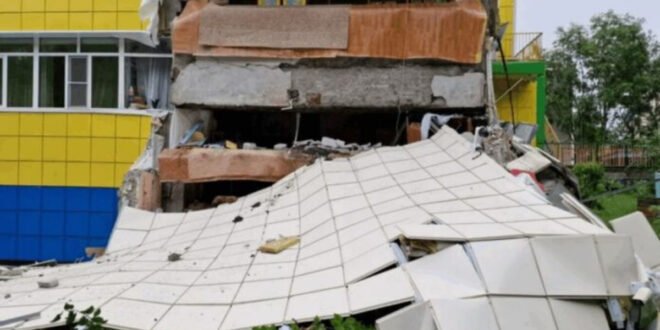
A catastrophic magnitude 8.8 earthquake struck off the coast of Russia’s Kamchatka Peninsula on Wednesday, July 30, 2025, sending powerful tsunami waves across the Pacific and forcing hundreds of thousands to flee coastal areas.
The quake, which the Russian Academy of Sciences identified as the strongest to hit the region since 1952, was centered just 74 miles from the city of Petropavlovsk-Kamchatsky at a shallow depth of 12 miles. Kamchatka Governor Vladimir Solodov described the tremors as the most serious in decades, as regional officials reported a series of strong aftershocks, including one measuring magnitude 6.9, that continued to rattle the geologically active “Ring of Fire” zone.
The earthquake generated immediate tsunami waves of up to 4 meters along the Kamchatka coastline, leading to the partial flooding of the port and a fish processing plant in the Sakhalin town of Severo-Kurilsk. While most modern buildings in the region withstood the prolonged three-minute shaking, several injuries were reported, including a woman at a new airport terminal and an individual who leaped from a window in panic.
In Japan, the memory of the 2011 disaster prompted an urgent response; authorities issued evacuation orders for the eastern seaboard and halted work at the Fukushima nuclear plant as a precaution. Although only modest waves eventually reached Japan’s coast, the sight of fishing boats heading to sea and residents huddling on rooftops underscored the high state of alert across the archipelago.
The threat extended thousands of miles across the Pacific, prompting U.S. President Donald Trump to issue a warning for Hawaii, Alaska, and the U.S. West Coast. In Hawaii, emergency management officials ordered residents in low-lying areas to move to higher ground or at least the fourth floor of sturdy buildings as “hazardous” waves were forecasted.
Similar warnings and watches reached as far as Ecuador and Chile. While the Pacific Tsunami Warning Center noted that the most destructive waves remained localized near the epicenter, the event triggered a massive logistical challenge as nations from the Solomon Islands to North America coordinated real-time evacuations to prevent loss of life.
By late evening, seismologists in Kamchatka indicated that while aftershocks would likely persist with high intensity, the immediate threat of a larger follow-up quake had subsided. Russian emergency services confirmed that while a kindergarten and several port facilities suffered structural damage, there were no reported fatalities in the initial hours following the disaster.
International monitoring stations continue to track smaller sea-level fluctuations across the Pacific basin, advising residents to remain cautious and follow local guidance until all tsunami advisories are officially lifted.